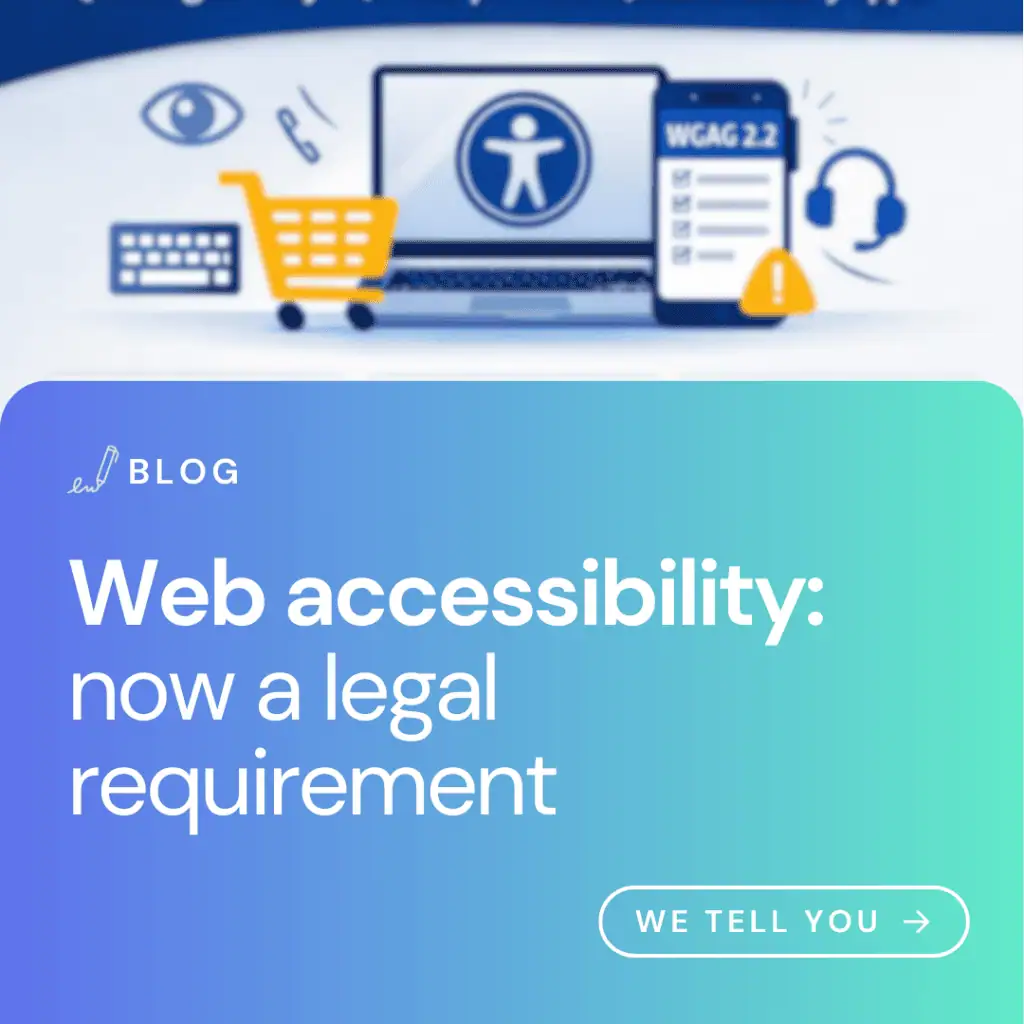

Law 11/2023, which transposes Directive (EU) 2019/882 of 17 April on the accessibility requirements for products and services, introduces significant changes for companies with a digital presence.
Under this regulation, accessibility becomes a general legal requirement for e-commerce websites, mobile applications and, more broadly, any digital service offering products or services within the European Union.
An accessible website is one that can be used without barriers. Not only by people with visual, hearing, motor or cognitive disabilities, but also by older users or those with lower digital skills.
Put simply, accessibility means your website does not exclude users based on how they navigate or perceive information.
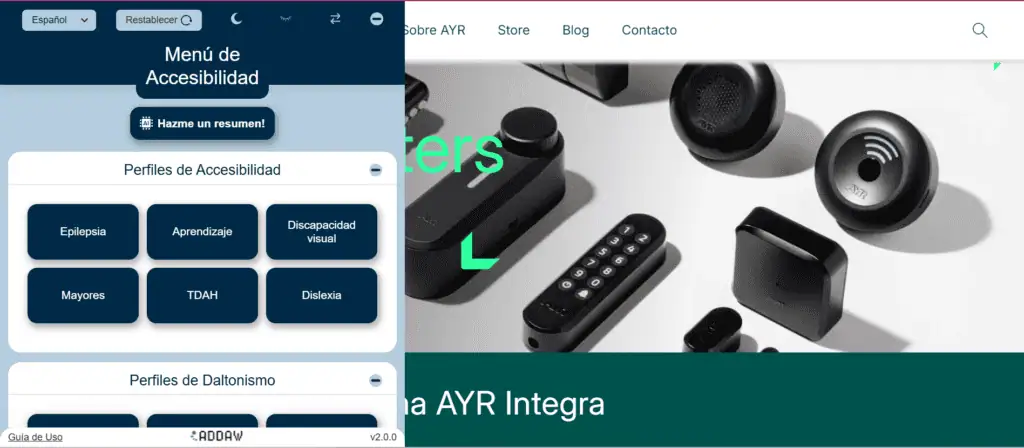
In practice, this includes elements such as subtitled videos, sufficient text contrast to improve readability, and alternative text for images that screen readers can interpret.
From a technical standpoint, the regulation requires compliance with WCAG 2.2, the international web accessibility standard developed by the World Wide Web Consortium (W3C).
WCAG defines three levels of conformance — A (basic), AA (recommended), and AAA (advanced) — and is based on four core principles:
Compliance with levels A and AA is essential to meet legal requirements in e-commerce.
In addition, the obligation is not limited to the website itself. The standard UNE-EN 301549 extends accessibility requirements to the entire digital service, including software, interactive devices, documentation and customer service channels.
This is one of the most important aspects.
What happens if your “old” website changes?
If a previously existing website is completely redesigned or undergoes changes that significantly alter user interaction, it may no longer be considered pre-existing and could be required to comply immediately.
You must provide clear and accessible information about how the service works, its level of accessibility, and its compatibility with assistive technologies.
The website or app must be navigable without obstacles, with content that is perceivable through different senses, structured in a clear and understandable way, and compatible with current and future screen readers.
Customer support must also be accessible — whether via telephone, chat or other channels — enabling use by people with disabilities and offering adapted communication formats.
And, of course, the entire purchase and payment process must be completed without barriers at every stage: identification, security and transaction confirmation.
It is not enough for the service to be accessible. You must also be able to prove it.
Companies are required to state in their general terms and conditions or equivalent documentation how accessibility requirements are met, keep this information updated, and provide it in accessible formats.
Digital accessibility is now a legal obligation for companies operating online.
Complying not only reduces the risk of fines and reputational damage — which may reach up to one million euros — but also improves user experience, strengthens search engine positioning and expands your potential customer base.
Across Europe, millions of people live with some form of disability. Accessibility is therefore not only a compliance issue, but a key factor for inclusion and business competitiveness.
At Lawwwing, we support companies in adapting their websites and digital services to accessibility regulations, turning legal compliance into a real growth opportunity..