
If you run an ecommerce business, you've probably wondered whether the product images your suppliers send you to upload on your website have been generated or retouched with artificial intelligence.
Between suppliers sending pre-enhanced product photos, agencies using virtual models for their photo shoots, and retouching tools that now come with AI built in by default, the true origin of an image has become difficult to trace. And since August 2nd, the EU's Artificial Intelligence Regulation will require you to identify this type of content, and failing to do so could result in substantial penalties.
In this article, we explain what visual signals you can spot with the naked eye, but more importantly, we provide you with the best solution specifically designed to know for certain and save yourself from penalties.
Although AI models are becoming increasingly sophisticated, there are still visual patterns that reveal their artificial origin. Here are the most reliable indicators:
Just a few years ago, distinguishing an AI-generated image was relatively straightforward—you simply needed to look for the telltale details we just mentioned. However, those errors have largely disappeared today. This is because the latest image generation models produce results so detailed and coherent that, at first glance, they are virtually indistinguishable from real photographs. Even a trained eye cannot reliably guarantee whether an image is authentic or synthetic just by looking at it, making visual detection an increasingly unreliable method.
The European Union's Artificial Intelligence Regulation establishes that images generated or significantly manipulated by AI that could be confused with real content must be clearly labeled when published. This includes, for example, AI-generated people that appear realistic in a context that simulates authentic photography.
And here's the critical point: as a website owner, you are responsible for the content you publish—even if the image was sent to you by a supplier or agency.
The penalties for non-compliance can be substantial. If you'd like to understand in detail what happens if you fail to comply with the AI Regulation and how it could impact your business, we recommend reading our article "What Happens on August 2nd If Your Website Doesn't Comply with the AI Act?", where we analyze the penalties and enforcement procedures through Spanish authorities.
Since manual review isn't viable and visual cues are no longer reliable, the reasonable alternative is to use a tool that automatically and continuously analyzes all the images on your website. That's exactly what AI Sentinel, by Lawwwing, does.
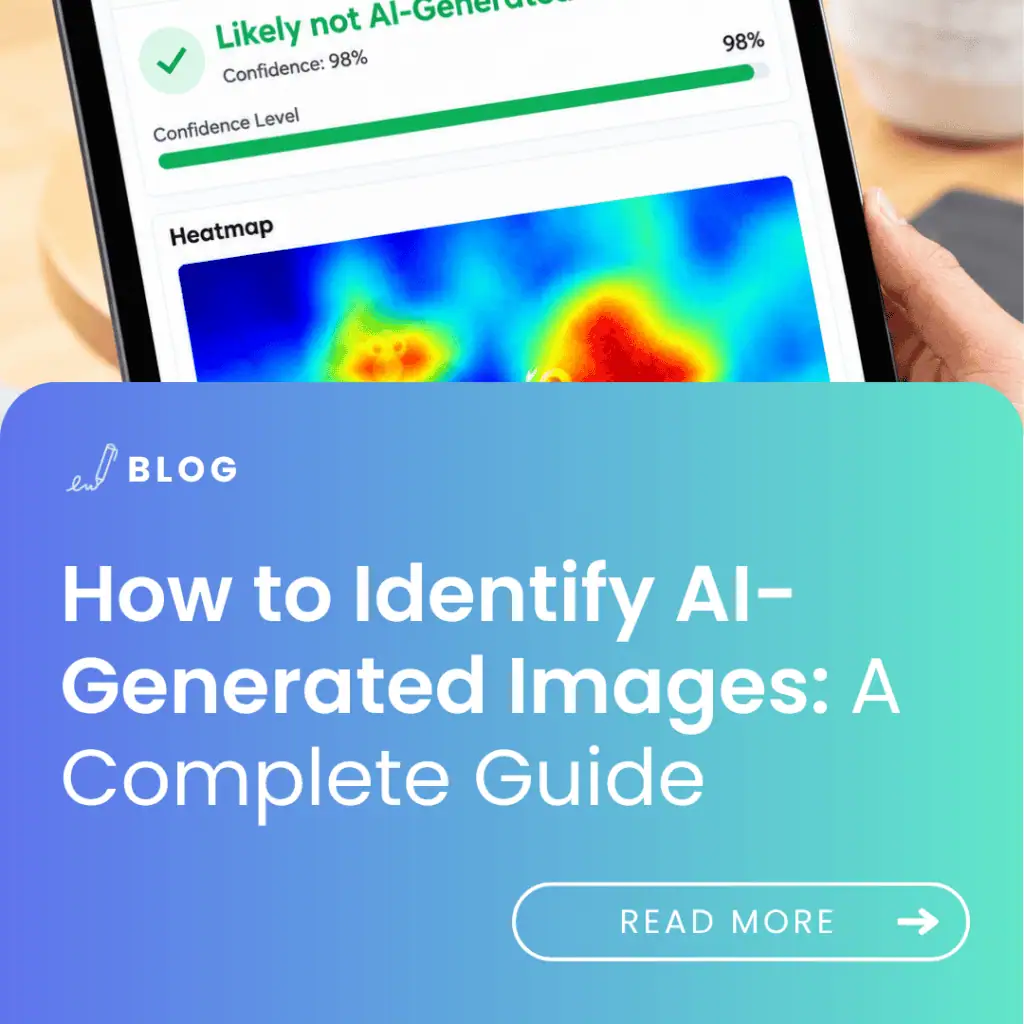
AI Sentinel periodically scans the images published on your website and analyzes them with its own detection engine, trained on millions of images. The process identifies visual patterns imperceptible to the human eye that distinguish a real image from an AI-generated one, with over 98.5% accuracy.
Beyond compliance, we also care about your business. At Lawwwing, we believe that disclosing the use of AI-generated content shouldn't hurt your store's sales. That's why AI Sentinel doesn't place labels directly on your product images; instead, it presents this information through a floating, accessible widget that doesn't alter your website's design or the shopping experience. This way, our solution helps you comply with the AI Act without compromising your ecommerce experience.
That said, AI Sentinel is designed for a very specific use case: continuously auditing images that are already published on your own website. If your needs go a step further as verifying images before publishing them, validating content uploaded by your users or suppliers, or checking the authenticity of evidence within a legal process, the same Lawwwing team offers Vericta, an image and video verification API built on the same detection technology and with the same level of accuracy.
While AI Sentinel automatically monitors your website, Vericta lets you integrate that same detection capability directly into your own workflows.
In short: if you need to identify content already published on your site, AI Sentinel is the right tool; but if you also need to verify content before it enters your system, Vericta has you covered.
Technically, you're in breach of the AI Regulation. As a website owner, you bear the responsibility, even if you didn't know the image was AI-generated.
You only need to label images that are actually generated or significantly manipulated by AI. Real images don't require a label. AI Sentinel helps you identify exactly which images are AI-generated or modified, so you only label the ones that need it.
If the manipulation is significant, it must be labeled. AI Sentinel and Vericta detect both cases.
You won't always know. That's why it's important to verify with automated tools. Vericta can be integrated into your supplier onboarding process.
AI Sentinel and Vericta offer accuracy above 98.5%. This means they correctly detect AI images in 98 out of 100 cases. The remaining 1.5% corresponds to edge cases where even human experts would hesitate.