
When we think about Black Friday, we think about discounts, ads and email campaigns. And we often forget about the legal side of the website. Even if it doesn't seem like it, it's also what decides whether your campaign goes well or gives you headaches weeks later, when the return requests start arriving.
This year Black Friday falls on 27 November, and it arrives with recent legislative changes. Here is the checklist to make sure your e-commerce store is truly ready, not just in terms of pricing.
If you invest in Google Ads, Meta or remarketing, the cookie banner is not a formality: it is what allows you to correctly measure your campaigns' conversions.
A poorly configured banner can breach the regulations (cookies activated without valid consent) or block tracking, meaning you lose metrics data in the very week you sell the most.
So this is what you need to check:
Black Friday is also an opportunity to collect data. To collect your customers' data properly and then reach them with your mailing campaigns, you need a complete and up-to-date Privacy Policy, and clear consent clauses on every form.
If your policy doesn't reflect the services you actually use (payment gateway, email marketing tool, analytics), your database could end up in a compromised position just when you need it most.
The discount period generates more orders, and also more returns. Your terms of sale are the document that says, clearly, who pays for what. For example, who bears the cost of shipping the return when the customer exercises their right of withdrawal.
If this isn't well drafted, doubts turn into complaints, chargebacks and a bad reputation. Before the campaign, check that your terms cover:
This is the question that generates the most complaints, and the answer depends on what you have written in your terms. As a general rule, if the customer exercises their right of withdrawal, they bear the direct cost of returning the product, unless you have agreed to pay it or you haven't informed them that it is their responsibility.
| Situation | Who pays for return shipping |
|---|---|
| Your terms clearly state that you do not offer free returns | Customer |
| Your terms clearly state that you offer free returns | You |
| You haven't informed customers of the cost in your terms | You |
If you are going to offer free returns only during Black Friday, say so explicitly in your Terms of Sale and include the dates of the promotion. That way you avoid it being interpreted as a permanent condition.
Not all products allow withdrawal. So, if you sell any of the following, it must be covered in your Terms of Sale:
The most important new development for e-commerce stores is the withdrawal button. Since June, it is mandatory to offer a function that allows consumers to exercise their right of withdrawal easily, so that withdrawing is as simple as buying.
This is not a minor technical detail. It is the door through which the returns from all your Black Friday purchases will come in, and it has to work properly before the peak of orders arrives. Therefore, it is also very important that your Terms of Sale provide a simple withdrawal mechanism so your customers can exercise their rights.
On top of all this regulation comes the harmonised guarantee label, another consumer information obligation that came into force a few months ago. This new rule requires implementing a new system of pre-contractual information on customers' legal and commercial guarantees.
If you sell products with a legal guarantee, check as soon as possible how and where you must display it on your product page and in your checkout process.
Since 27 September 2026, all stores, physical and online, have new obligations to provide information about guarantees. They come from Directive (EU) 2024/825 and take shape in two distinct elements: the harmonised notice and the GARAN label. This regulation already applies and is in force, so your website must display them before Black Friday arrives.
To understand what you need to display, you have to distinguish between two concepts:
| Harmonised notice | Harmonised label (GARAN) | |
|---|---|---|
| Guarantee it refers to | Legal guarantee of conformity | Commercial durability guarantee |
| Who offers it | The seller, by law | The producer, voluntarily |
| Is it mandatory to display? | Always | Only if certain requirements are met (see below) |
| Where it goes in an e-commerce store | On the website, as a general reminder | On the product page and before payment |
| Online format | In colour (RGB) | In colour; a reduced version is permitted |
The label is only mandatory if all of the following requirements are met:
It is a reminder of consumers' minimum legal rights in the EU, and it serves to prevent them from confusing these with a commercial guarantee. In an e-commerce store it must appear prominently and visibly on your website, always in colour (RGB), following the European Commission's standard design.
It must include:
Unlike the notice, the label is only mandatory when these four conditions are met at the same time:
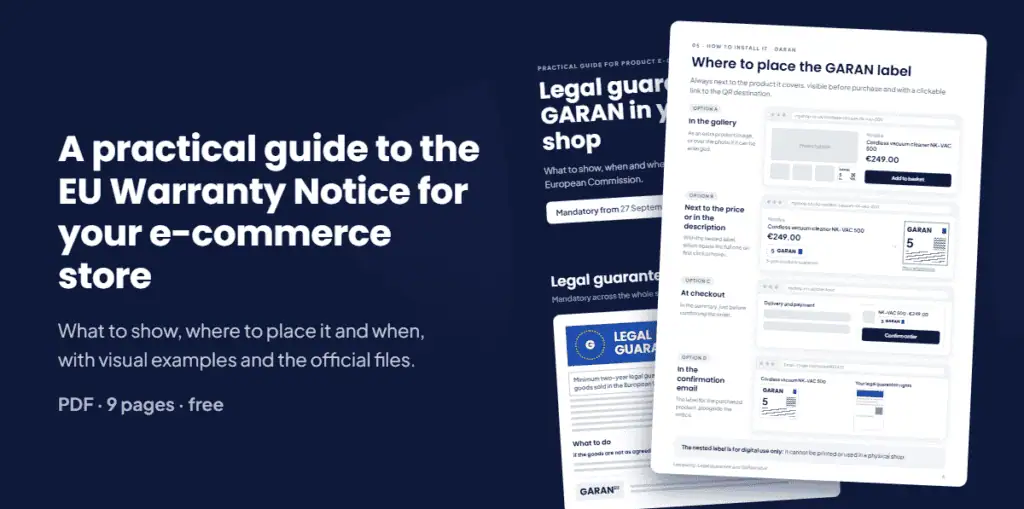
The official designs of the notice and the label, with their QR codes, can be downloaded from the European Commission's website. Before publishing them, check that the QR codes work and that you only display the label on products that meet the conditions.
If you want the full details, you can find them in our guide to the harmonised notice and label.
Preparing for Black Friday is not just having stock, offers and campaigns ready. It's having your website prepared for when the returns and withdrawals arrive from those who bought during the discount period.
If everything is properly sorted from the start (cookies, privacy, terms, withdrawal button and guarantee), those returns are handled without surprises and without the risk of penalties.
At Lawwwing we automate all of this so you can focus on selling.
To measure your campaigns properly without breaching the regulations, we provide the cookie banner and CMP, compatible with Google Consent Mode V2, Meta and Microsoft UET. This way, you respect your visitors' consent and don't lose conversion data just when you sell the most.
To collect data and write to your customers in compliance with the regulations, you can generate your Privacy Policy and Cookie Policy and the consent collection clauses that your forms and newsletter need.
To regulate returns and who pays the shipping costs, you have terms of purchase adapted to your store and your country. And to manage all withdrawals in one place, you have the withdrawal button for e-commerce.
And so as not to leave any customer out, the web accessibility solution helps you comply with the European Accessibility Act.
In addition, your texts are generated to fit your business and, when the regulations change, they are updated automatically because we have a legal team behind us working constantly so that you comply with everything.
Lawwwing integrates with the most common e-commerce platforms, such as Shopify, WordPress, PrestaShop, Magento or Wix. So all you have to do is install the banner and the legal texts, and we take care of the rest.
With the legal side sorted, you can dedicate the campaign to what matters: selling, and handling returns while complying with everything.
Activate your compliance before Black Friday and start for free with Lawwwing.